
Growth in B2B starts with perception. And increasingly, that perception is shaped not just by what your company says, but by who your leaders are and how they show up in the market.
This is where executive branding moves from a vanity exercise to a strategic growth lever.
The Shift: From Corporate Voice to Human Authority
For years, B2B brands invested heavily in corporate messaging like polished websites, whitepapers, and demand generation funnels. But the buying journey has evolved. Today’s buyers don’t just evaluate products; they evaluate people.
Research consistently shows that individuals outperform brands in building trust. In fact, 92% of people trust recommendations from individuals over brands, and executive-led content can drive significantly higher engagement and conversion rates.
This shift matters because B2B decisions are inherently high-risk. When deal sizes grow and buying committees expand, trust becomes the currency that moves decisions forward. Executive branding is how trust is built at scale.
Executive Branding as Trust Infrastructure
At its core, executive branding is about credibility.
According to the Edelman-LinkedIn research, 73% of decision-makers say thought leadership is more trustworthy than traditional marketing materials. Meanwhile, 99% of senior executives consider it critical when evaluating partners.
This changes the role of leadership content entirely. It is no longer a top-of-funnel awareness play. It becomes a mechanism for:
- Reducing perceived risk
- Influencing shortlist creation
- Accelerating consensus across buying groups
Today, buyers already identify a preferred vendor before engaging in formal procurement. That preference is often shaped long before a sales conversation through consistent exposure to executive insight.
The Commercial Impact: From Visibility to Revenue
The impact of executive branding is measurable.
- 77% of B2B buyers are more likely to purchase from companies whose leadership is active online
- 48% of thought leadership content directly generates leads and sales
- Nearly 60% of decision-makers have awarded business based on thought leadership alone
More importantly, executive content generates demand and shapes it. When leaders consistently share perspectives, they frame industry narratives, influence problem definitions, and position their company as the default solution. This is what most demand generation strategies miss. Demand is created upstream through trust and authority.
The Differentiation Problem (and Opportunity)
As more companies invest in thought leadership, content is becoming indistinguishable. 57% of buyers say most thought leadership feels the same, and 66% would disengage from providers with weak or generic perspectives.
This is where executive branding becomes a competitive advantage. Because while company messaging often converges, individual perspective does not. Your leadership team has something your competitors cannot replicate:
- Lived experience
- Market conviction
- Point of view shaped by real decisions
The market is not looking for more content. It is looking for sharper thinking.
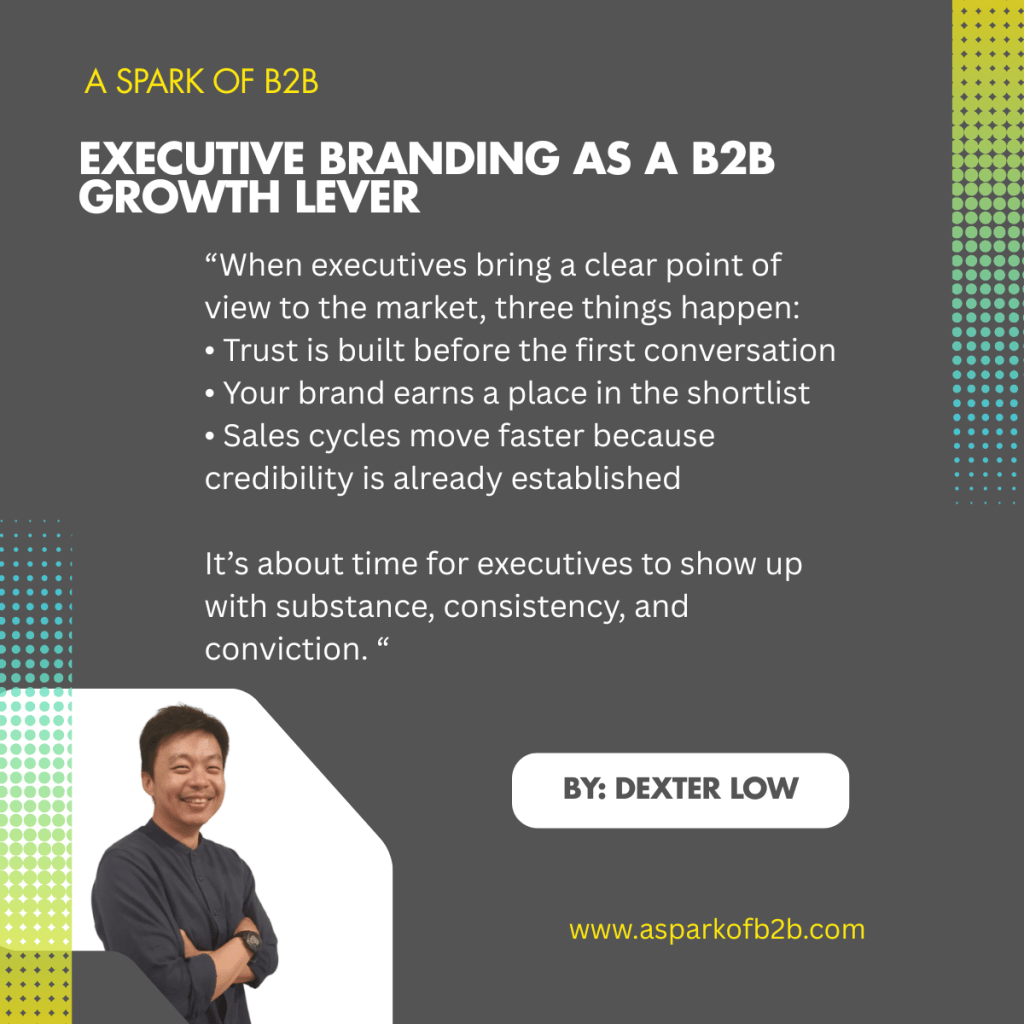
From Content Strategy to Leadership Strategy
To unlock executive branding as a growth lever, organizations need to rethink how they approach it. This is not about asking executives to “post more on LinkedIn.” That mindset leads to noise. Instead, it requires:
- Point of View Development: Executives must take clear positions on industry trends, not just report on them.
- Consistency Over Virality: Trust compounds through repeated exposure, not one-off viral posts.
- Alignment with Business Strategy: Executive narratives should reinforce the company’s market positioning and commercial priorities.
- Substance Over Volume: Given that only a small fraction of thought leadership is considered high quality, depth becomes the differentiator.
The Bottom Line
Executive branding is a business asset. In a market where buyers complete a significant portion of their journey independently, leadership visibility becomes a proxy for company credibility. It influences who gets considered, who gets trusted, and ultimately, who gets chosen.
The companies that understand this are building influence systems, where executives act as distribution channels, trust anchors, and growth drivers. In modern B2B, your brand is what your leaders stand for and how consistently they show up to prove it.
You Might Also Like…
Building Trust in APAC: Why B2B Brand Strategy Must Be Strategically Intelligent
Brand as a Revenue Engine: How B2B CMOs Become Growth Architects
What’s Next for B2B Podcasting? 2026 Trends and Insights
Disclaimer note:
The opinions expressed in this post are those of the author. They do not purport to reflect the opinions or views of any company or its associates.
Follow me on my digital channels:
Website: https://asparkofb2b.com/
Facebook (A spark of B2B) https://www.facebook.com/profile.php?id=100089042254709
Twitter (aSparkofB2B) https://twitter.com/aSparkofB2B
LinkedIn (a-spark-of-b2b) https://www.linkedin.com/company/a-spark-of-b2b
Medium https://medium.com/@dexterwrites2022
#B2BMarketing #ExecutiveBranding #ThoughtLeadership #BrandStrategy #DemandGeneration #PersonalBranding #B2BGrowth #LinkedInMarketing #ContentStrategy #DigitalMarketing

