
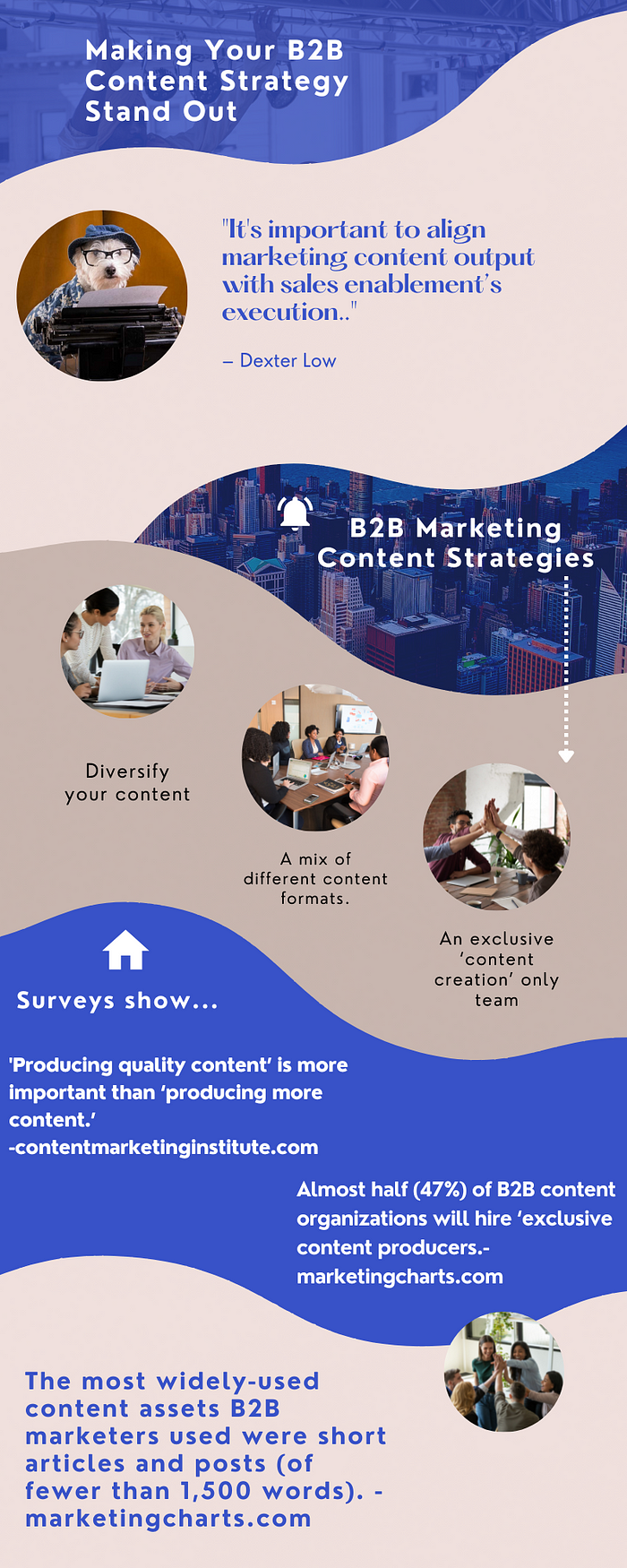
A recent July survey of 925 content marketers from for-profit B2B companies has shown that in order to make their content stand out from the competition, ‘producing quality content’ is more important than ‘producing more content.’ However, what goes behind the scene into producing great quality content? Let’s dive in!
Diversify Your Content
People have different preferences for how they consume information, some prefer reading, others watching videos, some listening to podcasts, etc. By diversifying your content, you can appeal to a wider range of people and increase the chances that your content will be consumed and retained.
By creating different types of content, you can increase your visibility on different platforms and in different search results. This can help you reach a wider audience and increase the chances that your target market will find your content.
Diversifying your content can also help you showcase your expertise in different areas. This can help establish your brand as a thought leader in your industry and increase trust and credibility.
Diversifying your content can keep your audience engaged by providing new and fresh information. This can help increase retention and the likelihood that your audience will return to your site or consume more content.
Have an Exclusive ‘Content Creation Only’ Team
While it is acknowledged that great content is important for brand visibility and engagement, often, the creative team behind it is the most misunderstood part of this equation. Every marketing team wants to produce better content, but having the right people on board to do so helps.
In fact, almost half (47%) of B2B content marketers overall said that they believe their B2B organization will hire or contract ‘exclusive content producers’ (writers, designers, photographers, videographers) in 2023.
BUT be mindful of their inherent role in content production, as they are often required to align marketing content output with sales enablement’s execution. Too often, salespeople in the same org are left in the dark about marketing content strategies which leads to passive sales prospecting. This skill is likely to be a mandatory requirement for similar content roles in the future.
Choose a Mix of Content Types
A mix of different content formats, such as blog posts, infographics, videos, and e-books, is essential for appealing to different learning styles and preferences. The most widely-used content assets B2B marketers created in the past year were short articles and posts (of fewer than 1,500 words), as cited by almost 9 in 10 (89% of) respondents.
Other content types such as virtual events/webinars/online courses (62%), infographics/charts/data viz/3D models (61%), and long articles/posts (61%) also popped up as key findings in the survey.
One of the potential growth content types would be in the form of video content, as evidenced by the need for digital engagement due to the pandemic in the last 2 years and changing inflation to produce more ROI on lesser spent.
Video contents are more likely to be retained by viewers. People can remember 95% of a message when they watch it in a video, compared to 10% when reading it in text. The other hidden benefit is that it strengthens the content production team’s potential as there is greater flexibility in creativity expressiveness.
And to cap it off for today’s article, continuously evaluate your content strategy and make adjustments as needed to ensure that it meets your business goals.
Disclaimer note: The opinions expressed in this post are those of the author. They do not purport to reflect the opinions or views of ThinkLogic Media Group or any company and their associates.
You can follow me on my socials:
Facebook (A spark of B2B) https://www.facebook.com/profile.php?id=100089042254709
Twitter (aSparkofB2B) https://twitter.com/aSparkofB2B
Linkedin (a-spark-of-b2b) https://www.linkedin.com/company/a-spark-of-b2b

